Quick Summary
- Tension headaches at the desk often come from postural lock and stress — not just “pain to numb.”
- Three points give fast relief without medication:Hegu (LI4)、Fengchi (GB20)、Taiyang (EX-HN5)— lining quality, blood flow, immune balance, and hormone timing matter.
- Use deep circular or static pressure for 60–90 seconds per point.for 3 minutesreset.
- This routine manages symptoms; recurring headaches may need clinical acupuncture for root-cause repair.
- Ideal for busy executives who need focus restored between meetings.
When you are deep within a highly demanding work session in Hong Kong’s competitive financial centers, an unexpected wave of head pain can halt your momentum. Many corporate leaders instinctively reach for pharmaceutical blockers to push through their schedules.
However, this clinical approach only dulls your sensory receptors while leaving the true physical strain unaddressed. Instead of relying on systemic chemicals, you can leverage your own neural pathways to down-regulate pain right from your office chair.
By applying targeted pressure to specific neuromuscular junctions, you can instantly break the neural feedback loops responsible for tension-type and stress-induced discomfort.
How do you relieve a tension headache at your desk instantly?
Key Extract
To relieve a tension headache instantly at your desk, apply deep circular pressure to theHegu (LI4)point on your hand, press firmly into the suboccipital hollows at the base of your skull via theFengchi (GB20)point, and massage the Taiyang points at your temples forTaiyangpoints at your temples for 3 minutes60 to 90 seconds to reset myofascial tone.
| Acupoint Name | Precise Anatomical Location | Primary Neurological Focus |
|---|---|---|
| Hegu (LI4 / 合谷) | The midpoint of the first dorsal interosseous muscle between thumb and index | Modulates general pain signaling across the upper body |
| Fengchi (GB20 / 風池) | The bilateral depressions between the trapezius and sternocleidomastoid muscles | Relieves deep suboccipital muscle strain and postural lock |
| Taiyang (EX-HN5 / 太陽) | The soft tender hollow located one thumb-width posterior to the brow apex | Relaxes temporal myofascial sheets and relieves eye strain |
The 3-Minute At-Desk Neural Reset Protocol
1. Hegu (LI4): The Universal Neuro-Modulator
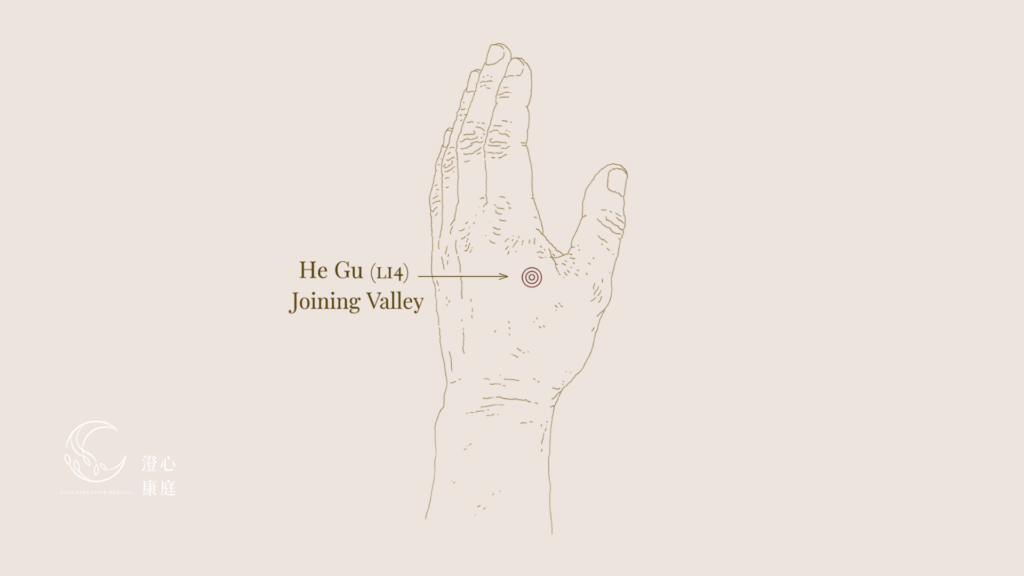
The Hegu point is widely recognized as one of the most potent analgesics in systemic acupressure. Located in the web space between your thumb and first finger, this area maps directly onto branches of the superficial radial nerve.
- The Technique: Extend your hand open. Use your opposite thumb to pinch the muscular web firmly. Rotate your thumb in deep, slow clockwise circles.
- The Sensation: You should actively chase a profound, heavy dull ache. If it feels intensely sensitive, you have found the right nerve path.
- Duration: Hold and massage for 60 seconds, then switch sides.
2. Fengchi (GB20): Decompressing the Cranial Base
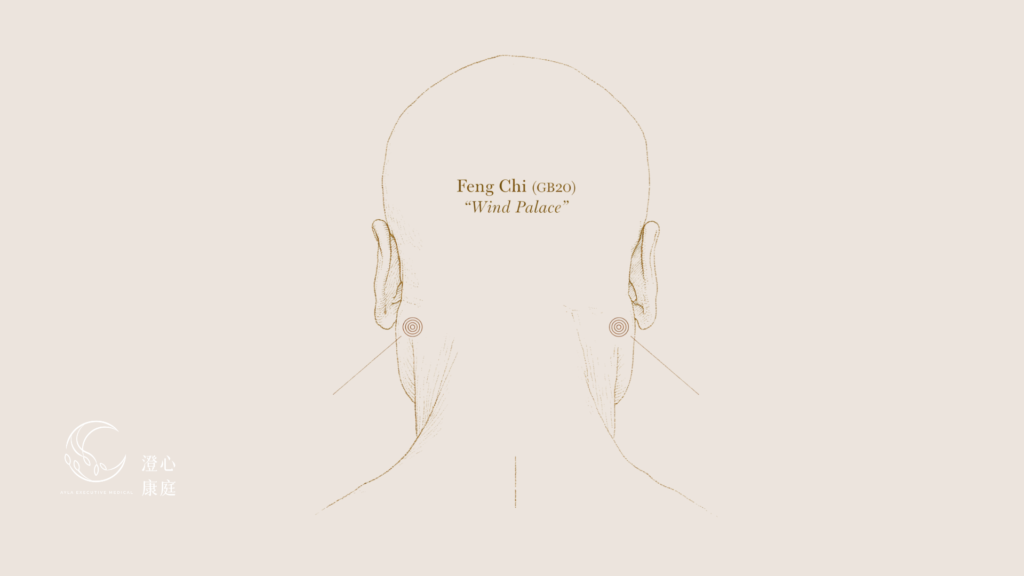
If you spend your days looking at large external monitors or reading through documents, your suboccipital muscles are likely locked in a chronic contraction, irritating the greater occipital nerve paths.
- The Technique: Place both thumbs into the hollows at the base of your skull, right where your neck muscles join the cranium. Interlace your fingers around your head for support.
- The Sensation: Press firmly inward and upward toward your eyes. Tilt your chin slightly downward to maximize the physical release.
- Duration: Apply continuous static pressure for 90 seconds while breathing deeply.
3. Taiyang: Releasing Temporal Fascial Sheets
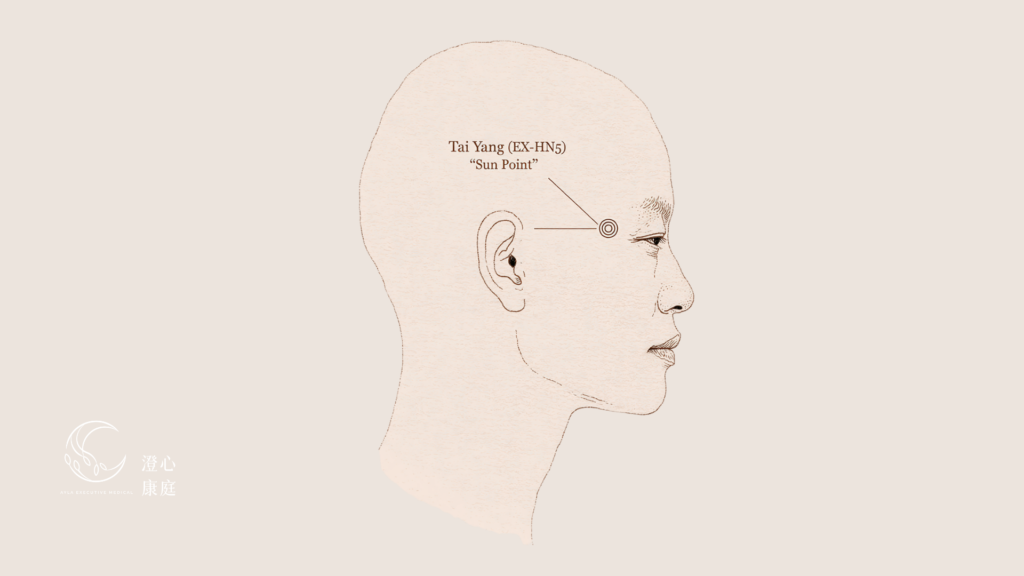
When structural eye strain from blue-light screens triggers a radiating ache behind your eyes, the temporal sheets require immediate myofascial decompression.
- The Technique: Position the pads of your index and middle fingers into the soft depressions at your temples.
- The Sensation: Apply a gentle yet deep inward pressure, moving your fingers in micro-circles backward toward your ears.
- Duration: Continue this slow, repetitive circular motion for 60 seconds.
From At-Desk Management to Clinical Deep Repair
While these at-desk acupressure interventions provide excellent short-term relief, they primarily manage symptoms on the surface. Recurring office headaches are usually clear indicators of deep-seated mechanical or energetic imbalances — such as spinal structural misalignment, suboccipital micro-scarring, or chronic stress-induced neurovascular inflammation.
At Ayla Executive Medical, our registered Chinese Medicine practitioners integrate these classical practices with modern physiology. Our targeted clinical acupuncture treatments use ultra-fine filiform needles to reach down into spasming tissues that manual pressure simply cannot clear. This precise approach promotes long-term microcirculation, systematically calms hyper-excitable cranial nerves, and permanently restores your performance potential.
FAQ
Why does the Hegu point feel so tender when I massage it during a headache?
The tenderness you experience indicates that the nerve signaling pathway is highly active. In neuromodulation, high-density sensory areas like the first dorsal interosseous muscle correspond directly to large sensory mapping networks in the cerebral cortex. Massaging this tender point sends a strong mechanical signal that closes the neurological gates in your brain stem, effectively muting head pain.
How often can I perform this desk-side acupressure routine safely?
You can safely utilize this physical routine whenever you feel tension building throughout your workday. Because it is completely non-pharmacological, there is zero risk of developing rebound headaches or liver stress — common issues associated with the over-use of standard pharmaceutical painkillers.
When should I transition from self-care acupressure to professional clinical care?
If you find yourself relying on acupressure multiple times a week just to maintain your concentration, or if your pain patterns evolve into sharp, throbbing unilateral spikes accompanied by sensory sensitivity, you should transition to clinical care. These shifts indicate that your system requires professional neurovascular intervention rather than simple surface muscle care.
Reclaim Your Focus at Ayla Executive Medical
Do not let chronic physical tension limit your leadership performance. Temporary self-care is a valuable tool, but resolving long-term performance bottlenecks requires a precise, root-cause strategy. Let our clinical practitioners identify the exact physiological drivers behind your discomfort and guide your system back to peak neurovascular health.